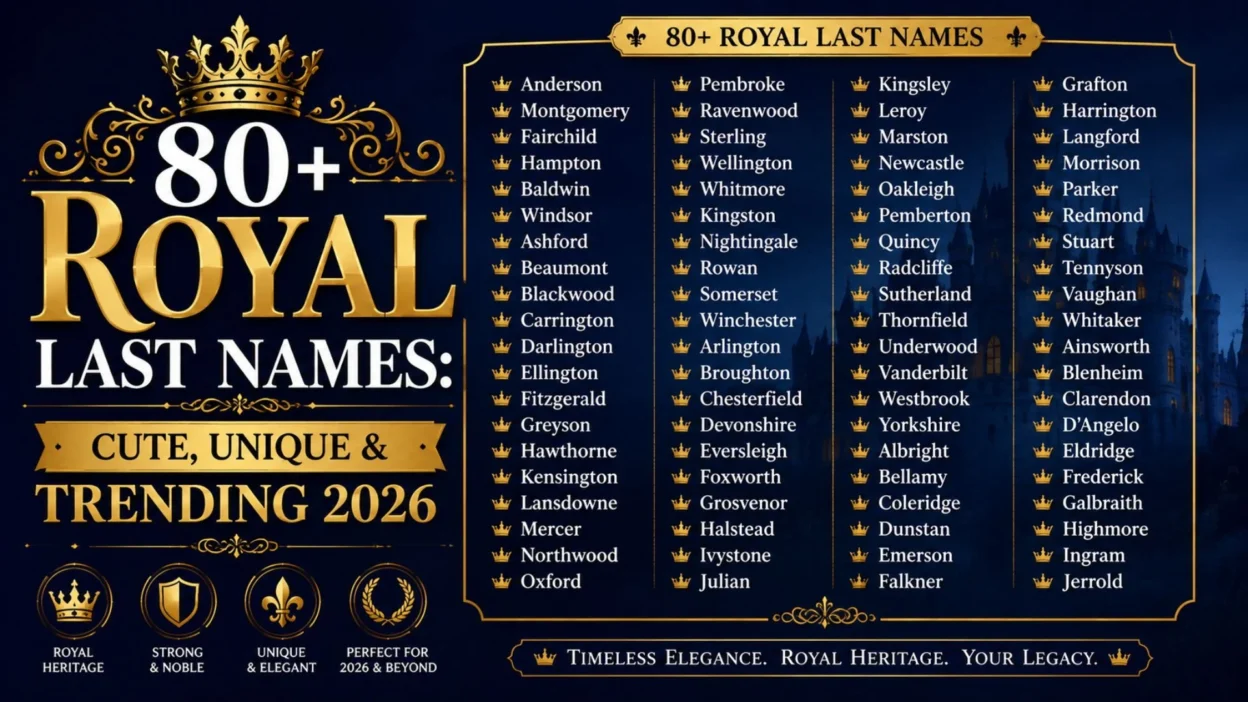
From the grand halls of Windsor Castle to the sun-drenched palaces of the Mediterranean, royal last names have captivated our imagination for centuries. These surnames carry weight, history, and an undeniable aura of power that few other names can match. Whether you’re tracing your family tree, naming a baby, crafting a fantasy novel, or simply curious about your own surname’s potential royal connections, the world of royal last names offers endless fascination. In 2026, interest in royal surnames has surged—driven by genealogy DNA testing, the enduring popularity of royal family dramas, and a cultural appetite for names that feel both historic and aspirational.
But royal last names aren’t just about crowns and castles. Many of these surnames have surprising origins, fascinating backstories, and unexpected connections to everyday people. Some of the most regal-sounding names started as humble occupations or geographical descriptors. Others were deliberately chosen to distance royal families from their foreign roots during times of war. And some of the most “royal” names on this list might already be in your family tree without you even knowing it. In this comprehensive guide, we’ve curated over 80 royal last names spanning continents, centuries, and cultures—from the well-known to the wonderfully obscure. Let’s explore the surnames that have shaped history and continue to inspire us in 2026.
👑 British Royal Last Names That Define an Empire
The British monarchy has given the world some of the most recognizable royal surnames in history. These names have shaped not just England but global history itself. From the medieval Plantagenets to the modern Windsors, British royal last names tell the story of a nation.
- Windsor – The current royal surname, adopted in 1917
- Mountbatten-Windsor – The double-barrelled surname for direct descendants of Queen Elizabeth II and Prince Philip
- Plantagenet – The ruling house of England for over 300 years
- Tudor – The Welsh dynasty of Henry VIII and Elizabeth I
- Stuart (Stewart) – The Scottish royal house that ruled England and Scotland
- Lancaster – A branch of the Plantagenet dynasty
- York – The rival branch in the Wars of the Roses
- Hanover – The German dynasty that ruled Britain from 1714 to 1901
- Saxe-Coburg-Gotha – The royal house before Windsor
- Wettin – The personal surname of Queen Victoria’s descendants
- Spencer – Princess Diana’s maiden name
- Howard – The Duke of Norfolk’s family
- Percy – The Earls of Northumberland
- Neville – A powerful medieval noble family
- Grey – The family of Lady Jane Grey, the “Nine Days’ Queen”
- FitzAlan – An ancient Norman noble family
- Courtenay – A prominent English noble house
- Manners – The family of the Duke of Rutland
- Russell – The Earls of Bedford
- Cavendish – The Dukes of Devonshire
- Talbot – The Earls of Shrewsbury
- Seymour – Jane Seymour’s family
- Boleyn – Anne Boleyn’s family
- Beaufort – A legitimized branch of the Plantagenets
The British royal family doesn’t actually have an official “last name” in the traditional sense—they have little use for one. But when a surname is needed, members use Windsor, Mountbatten-Windsor, or the territorial designation from their title (like Wales or Sussex).
🏴 Scottish Royal Surnames with Highland Pride
Scotland’s royal history is rich with powerful clans and fierce monarchs. These Scottish royal last names evoke images of misty highlands, ancient castles, and a proud independent spirit.
- Bruce – Robert the Bruce’s legendary family
- Stewart – The Scottish spelling of Stuart
- Alpin – Surname of the first King of Scotland
- Balliol – Former King John Balliol’s family
- Canmore – Malcolm of Canmore (Malcolm III)
- Barclay – Former Chamberlain of Scotland
- Robertson – Common surname for several Scottish kings
- MacAlpin – Another variation of the Alpin dynasty
- Duncan – From King Duncan I, immortalized in Macbeth
- MacBeth – The historical King of Scotland
- MacMalcolm – Descendants of Malcolm III
- MacDonald – Lords of the Isles with royal claims
- Campbell – The powerful Dukes of Argyll
- Douglas – The “Black Douglas” noble family
- Hamilton – A prominent Scottish noble family
- Dunbar – Earls of Dunbar
- Murray – The Earls of Atholl
- Fraser – Lords of Lovat
- Gordon – The Dukes of Gordon
- Leslie – The Earls of Rothes
- Sinclair – Earls of Caithness
- Keith – The Earls Marischal
- Cumming – The Comyn family, rivals of the Bruces
- MacKenzie – Earls of Seaforth
- MacLean – Lords of the Isles
The Stuarts (or Stewarts) remain the most famous Scottish royal surname, with Mary, Queen of Scots popularising the French spelling “Stuart” in the 16th century.
🇫🇷 French Royal Last Names from the Capetian Dynasty
France was home to some of Europe’s most powerful and enduring royal dynasties. French royal last names carry an air of elegance, sophistication, and revolutionary drama.
- Capet – The dynasty that ruled France from 987 to 1328
- Bourbon – The French royal house that also ruled Spain
- Valois – A cadet branch of the Capetian dynasty
- Orléans – A cadet branch of the Bourbons
- Bonaparte – Napoleon’s imperial family
- Medici – The Italian family that became French royalty through marriage
- Anjou – The Plantagenet branch that ruled in France
- Aquitaine – The Dukes of Aquitaine
- Angoulême – A branch of the Capetian dynasty
- Brittany – The Dukes of Brittany
- Lorraine – The Dukes of Lorraine
- Armagnac – A powerful French noble family
- Foix – Counts of Foix
- Albret – Kings of Navarre
- Montfort – Earls of Leicester and Dukes of Brittany
- Evreux – A Norman noble family
- Artois – A cadet branch of the Capetians
- Berry – A cadet branch of the French royal family
- Burgundy – The Dukes of Burgundy
- Champagne – Counts of Champagne
- Blois – Counts of Blois
- Toulouse – Counts of Toulouse
- Provence – Counts of Provence
- Savoy – The French-Italian royal house
The French Revolution scattered these noble surnames across the globe, and today they remain some of the most prestigious royal last names in history.
🇪🇸 Spanish and Portuguese Royal Surnames
The Iberian Peninsula has produced some of the most influential royal families in world history, from the Catholic Monarchs to the global Spanish Empire.
- Bourbon – The current Spanish royal house
- Castile – The royal house of Isabella I
- Aragon – The royal house of Ferdinand II
- Trastámara – The dynasty that united Castile and Aragon
- Habsburg – The Austrian dynasty that ruled Spain
- Braganza – The Portuguese royal house
- Aviz – The Portuguese dynasty that began the Age of Discovery
- Burgundy – The Portuguese royal house through marriage
- Barcelona – The Counts of Barcelona
- Navarre – The Kings of Navarre
- León – The Kings of León
- Asturias – The oldest royal title in Spain
- Galicia – The Kings of Galicia
- Córdoba – The Caliphs of Córdoba
- Alba – The Dukes of Alba
- Medina-Sidonia – The Dukes of Medina-Sidonia
- Osuna – The Dukes of Osuna
- Lerma – The Dukes of Lerma
- Olivares – The Count-Dukes of Olivares
- Mendoza – A powerful Spanish noble family
- Guzmán – The Dukes of Medina-Sidonia
- Pimentel – Counts of Benavente
- Toledo – The Dukes of Alba
- Granada – The Nasrid dynasty of Granada
🇩🇪 German and Austrian Royal Last Names
Germany and Austria were the heart of the Holy Roman Empire, producing some of the most complex and far-reaching royal dynasties in European history.
- Habsburg – The dynasty that ruled the Holy Roman Empire
- Hohenzollern – The Prussian and German imperial dynasty
- Wittelsbach – The Bavarian royal dynasty
- Saxe-Coburg-Gotha – The German royal house that became British
- Oldenburg – The Danish and Russian royal dynasty
- Glücksburg – The Danish and Greek royal house
- Hohenstaufen – The Holy Roman imperial dynasty
- Luxembourg – The medieval imperial dynasty
- Nassau – The Dutch royal house
- Hesse – The Landgraves of Hesse
- Baden – The Grand Dukes of Baden
- Württemberg – The Kings of Württemberg
- Mecklenburg – The Dukes of Mecklenburg
- Brunswick – The Dukes of Brunswick
- Hanover – The British royal house
- Saxony – The Kings of Saxony
- Bavaria – The Kings of Bavaria
- Austria – The Archdukes of Austria
- Carinthia – The Dukes of Carinthia
- Styria – The Dukes of Styria
- Tyrol – The Counts of Tyrol
- Salzburg – The Prince-Archbishops
- Brandenburg – The Margraves of Brandenburg
- Palatinate – The Counts Palatine
🇮🇹 Italian Royal Surnames from the Renaissance
Italy was a patchwork of kingdoms, duchies, and republics, each with its own royal or noble family. These Italian royal last names evoke the splendour of the Renaissance.
- Medici – The de facto rulers of Florence
- Savoy (Savoia) – The royal house of Italy
- Grimaldi – The ruling family of Monaco
- Borgia – The infamous papal family
- Sforza – The Dukes of Milan
- Este – The Dukes of Ferrara and Modena
- Gonzaga – The Dukes of Mantua
- Farnese – The Dukes of Parma
- Colonna – A powerful Roman noble family
- Orsini – A powerful Roman noble family
- Della Rovere – The Dukes of Urbino
- Montefeltro – The Dukes of Urbino
- Malatesta – The Lords of Rimini
- Scaliger – The Lords of Verona
- Visconti – The Dukes of Milan
- Carraresi – The Lords of Padua
- Della Scala – Another name for the Scaliger family
- Paleologo – The Byzantine imperial family in Italy
- Cantacuzino – A Byzantine noble family
- Vendramin – A Venetian noble family
- Cornaro – A Venetian noble family
- Foscari – A Venetian noble family
- Dandolo – A Venetian noble family
- Morosini – A Venetian noble family
🇷🇺 Russian Imperial Last Names
The Russian imperial dynasty ruled for over 300 years, leaving a legacy of grandeur, tragedy, and some of the most evocative royal surnames in history.
- Romanov – The last imperial dynasty of Russia
- Rurik – The founding dynasty of Russia
- Godunov – The dynasty that preceded the Romanovs
- Shuysky – A Russian noble family
- Obolensky – A Rurikid princely family
- Dolgorukov – A Russian princely family
- Galitzine – A prominent Russian noble family
- Yusupov – A Russian princely family
- Sheremetev – A Russian noble family
- Trubetskoy – A Lithuanian-Russian princely family
- Volkonsky – A Rurikid princely family
- Menshikov – A Russian princely family
- Ostrovsky – A Russian noble family
- Potemkin – The family of Catherine the Great’s favourite
- Orlov – The family of Catherine the Great’s lover
- Vorontsov – A Russian noble family
- Stroganov – A Russian merchant and noble family
- Demidov – A Russian industrialist and noble family
- Naryshkin – A Russian noble family
- Lopukhin – A Russian noble family
- Apraksin – A Russian noble family
- Tolstoy – A Russian noble family (yes, those Tolstoys)
- Pushkin – The poet’s noble family
🇸🇪 Scandinavian Royal Surnames
The Nordic kingdoms have some of the oldest continuous monarchies in the world, with royal surnames that reflect their Viking heritage.
- Glücksburg – The current Danish and Norwegian royal house
- Bernadotte – The current Swedish royal house
- Oldenburg – The ancestral Danish dynasty
- Vasa – The Swedish royal dynasty
- Palatinate-Zweibrücken – A branch of the Swedish royal family
- Holstein-Gottorp – The Russian imperial house through marriage
- Schleswig-Holstein – A German-Danish ducal house
- Sonderburg – A branch of the Oldenburgs
- Augustenburg – A branch of the Oldenburgs
- Denmark – The royal house of Denmark
- Norway – The royal house of Norway
- Sweden – The royal house of Sweden
- Iceland – The royal house of Iceland (historically)
- Finland – The royal house of Finland (historically)
- Gotland – A medieval royal house
- Jutland – A medieval royal house
- Scania – A medieval royal house
- Uppsala – A medieval royal house
- Lund – A medieval ecclesiastical principality
- Trondheim – A medieval Norwegian royal seat
- Bergen – A medieval Norwegian royal seat
- Roskilde – A medieval Danish royal seat
🇳🇱 Dutch and Belgian Royal Last Names
The Low Countries have produced distinctive royal houses that continue to reign today.
- Orange-Nassau – The Dutch royal house
- Saxe-Coburg-Gotha – The Belgian royal house
- Nassau – The ancestral house of the Dutch monarchy
- Brabant – The Dukes of Brabant
- Holland – The Counts of Holland
- Flanders – The Counts of Flanders
- Hainaut – The Counts of Hainaut
- Luxembourg – The Grand Ducal house
- Arlon – The Counts of Arlon
- Namur – The Counts of Namur
- Liège – The Prince-Bishops of Liège
- Utrecht – The Prince-Bishops of Utrecht
- Groningen – A Frisian noble family
- Friesland – The Counts of Friesland
- Gelderland – The Dukes of Gelderland
- Overijssel – A noble family
- Drenthe – A noble family
- Zeeland – The Counts of Zeeland
- Antwerp – A noble family
- Brussels – A noble family
- Ghent – A noble family
- Bruges – A noble family
🇬🇷 Greek and Balkan Royal Surnames
The Balkans and Greece have a complex royal history spanning Byzantine emperors to modern monarchies.
- Glücksburg – The Greek royal house
- Palaiologos – The last Byzantine imperial dynasty
- Komnenos – The Byzantine imperial dynasty
- Angelos – The Byzantine imperial dynasty
- Doukas – The Byzantine imperial dynasty
- Laskaris – The Byzantine imperial dynasty
- Cantacuzene – A Byzantine noble family
- Caragea – A Wallachian princely family
- Basarab – The founders of Wallachia
- Dracula – Yes, Vlad the Impaler’s family name
- Branković – A Serbian royal dynasty
- Nemanjić – The Serbian imperial dynasty
- Hrebeljanović – The dynasty of Prince Lazar
- Karađorđević – The Serbian royal house
- Obrenović – The Serbian royal house
- Hohenzollern-Sigmaringen – The Romanian royal house
- Batthyány – A Hungarian noble family
- Esterházy – A Hungarian noble family
- Ferdinand – The Romanian royal house
- Saxe-Coburg-Gotha-Koháry – The Bulgarian royal house
🌏 Asian Royal Last Names
Asia is home to some of the world’s oldest continuous monarchies, with royal surnames that carry millennia of history.
- Yamato – The Japanese imperial house
- Wangchuck – The Bhutanese royal house
- Bolkiah – The Bruneian royal house
- Norodom – The Cambodian royal house
- Chakri – The Thai royal house
- Hashim – The Jordanian royal house
- Saud – The Saudi royal house
- Sabah – The Kuwaiti royal house
- Khalifa – The Bahraini royal house
- Thani – The Qatari royal house
- Said – The Omani royal house
- Maktoum – The Dubai royal house
- Nahyan – The Abu Dhabi royal house
- Yusuf – A Malaysian royal house
- Idris – A Malaysian royal house
- Tuanku – A Malaysian royal title
- Raja – A Malaysian royal title
- Sultan – The Sultanate of Oman
- Temenggong – A Malaysian royal house
- Bendahara – A Malaysian royal house
- Sulu – The Sultanate of Sulu
- Magindanao – The Sultanate of Magindanao
🌍 African Royal Surnames
Africa has a rich tapestry of monarchies and royal dynasties, from ancient Egypt to modern kingdoms.
- Alawi – The Moroccan royal house
- Dlamini – The Swazi (Eswatini) royal house
- Zulu – The Zulu royal house
- Xhosa – The Xhosa royal house
- Ashanti – The Ashanti royal house
- Bemba – The Bemba royal house
- Buganda – The Buganda royal house
- Benin – The Benin royal house
- Dahomey – The Dahomey royal house
- Ethiopia – The Solomonic dynasty
- Egypt – The pharaonic dynasties
- Kush – The Kushite royal house
- Aksum – The Aksumite royal house
- Ghana – The Ghana Empire royal house
- Mali – The Mali Empire royal house
- Songhai – The Songhai Empire royal house
- Kanem – The Kanem-Bornu Empire royal house
- Bornu – The Kanem-Bornu Empire royal house
- Oyo – The Oyo Empire royal house
- Darfur – The Darfur Sultanate
- Wadai – The Wadai Sultanate
- Bagirmi – The Bagirmi Sultanate
🕌 Middle Eastern Royal Last Names
The Middle East has been home to some of history’s most powerful empires and continues to have influential royal families.
- Saud – The Saudi royal house
- Hashim – The Jordanian royal house
- Khalifa – The Bahraini royal house
- Sabah – The Kuwaiti royal house
- Thani – The Qatari royal house
- Said – The Omani royal house
- Maktoum – The Dubai royal house
- Nahyan – The Abu Dhabi royal house
- Rasheed – A Saudi noble family
- Sudairi – A Saudi noble family
- Al Faisal – A branch of the Saudi royal family
- Al Saud – The full name of the Saudi royal house
- Al Rashid – The rival of the Al Saud
- Al Maktoum – The Dubai ruling family
- Al Nahyan – The Abu Dhabi ruling family
- Al Sabah – The Kuwaiti ruling family
- Al Thani – The Qatari ruling family
- Al Said – The Omani ruling family
- Al Khalifa – The Bahraini ruling family
- Al Hashim – The Jordanian ruling family
- Osman – The Ottoman imperial dynasty
- Seljuk – The Seljuk imperial dynasty
- Ayyub – Saladin’s dynasty
- Mamluk – The Mamluk Sultanate
✨ Fantasy Royal Last Names for Storytelling
For writers, gamers, and world-builders, fantasy royal last names offer limitless creative possibilities. These names feel ancient, powerful, and utterly regal.
- Stormveil – Rulers of thunder and storms
- Frostwind – Cold yet powerful kings
- Ironcrest – An unbreakable dynasty
- Skyreach – Nobles of the heavens
- Blazefury – Fire-forged royalty
- Zerathyn – Rare ancient blood
- Velmoria – Elegant royal grace
- Aetherlyn – Born of magic
- Caldris – Balanced rulers
- Nyxorin – Twilight nobles
- Valorheim – Brave (Norse-inspired)
- Ashenmire – Fallen (Anglo-inspired)
- Crystalborne – Purity and power
- Dawnforge – Rising (Celtic-inspired)
- Vexstorm – Chaotic power
- Onyxblaze – Precise and powerful
- Solarcrown – Radiant (Latin-inspired)
- Voidwalker – Mysterious and powerful
- Goldcrown – Born to rule
- Silverthorn – Beauty and danger
- Ironthrone – Unshakeable rulers
- Ravencrest – Omen-bearing nobility
- Winterthrone – Rulers of a frozen capital
- Brightcrown – Beloved monarchs
- Nightvale – Rulers of endless shadows
Fantasy royal last names work best when they sound older than the characters carrying them—names like “Winterthrone” or “Starcrown” feel like they’ve been sworn fealty to for centuries.
🌟 Unique Royal Surnames That Sound Modern
Some royal last names have a surprisingly contemporary feel, making them perfect for modern characters, businesses, or even baby names.
- Windsor – Classic yet timeless
- Spencer – Elegant and modern-sounding
- Howard – Strong and contemporary
- Russell – Approachable yet distinguished
- Cavendish – Unique and sophisticated
- Percy – Short and punchy
- Grey – Minimalist and cool
- Bruce – Strong and straightforward
- Seymour – Distinctive and memorable
- Talbot – Unusual but wearable
- Manners – Quirky and aristocratic
- Stanley – Solid and respectable
- Douglas – Strong and Scottish
- Hamilton – Distinguished and American-friendly
- Campbell – Familiar yet noble
- Montgomery – Elegant and long
- Kennedy – Irish royalty-adjacent
- Livingston – Scottish nobility
- Montague – Romeo’s family name
- Capulet – Juliet’s family name
- Darcy – Mr. Darcy’s aristocratic surname
- Baskerville – Mysterious and gothic
👶 Cute Royal Last Names for Babies
Looking for a royal-inspired surname for a baby name? These options sound adorable yet carry the weight of history.
- Windsor – Strong and regal
- Spencer – Cute and classic
- Percy – Adorable and short
- Grey – Trendy and modern
- Bruce – Strong and sweet
- Stanley – Old-fashioned charm
- Douglas – Cute Scottish choice
- Hamilton – Distinguished and charming
- Campbell – Friendly and noble
- Montgomery – Fancy and fun
- Darcy – Romantic and cute
- Neville – Sweet and historical
- Astley – Unique and charming
- Capell – Quirky and rare
- Courtenay – Elegant and cute
- Manners – Whimsical and aristocratic
- Talbot – Unusual but sweet
- FitzAlan – Unique and historical
- Barclay – Scottish and cute
- Alpin – Short and royal
- Balliol – Unusual and historical
- Canmore – Strong and Scottish
- Robertson – Friendly and noble
📈 Trending Royal Last Names in 2026
As of 2026, certain royal last names are experiencing a surge in popularity—driven by pop culture, genealogy trends, and a renewed interest in heritage.
- Sussex – Prince Harry and Meghan’s chosen surname
- Windsor – Always trending
- Mountbatten-Windsor – Growing in recognition
- Spencer – Diana’s lasting legacy
- Middleton – Kate’s maiden name
- Markle – Meghan’s maiden name
- Wales – William and Kate’s territorial surname
- Cambridge – William and Kate’s former title
- Stuart – Classic Scottish royalty
- Tudor – Historical drama popularity
- Plantagenet – Medieval fascination
- Bourbon – French royal revival
- Habsburg – Historical intrigue
- Romanov – Russian imperial fascination
- Grimaldi – Monaco glamour
- Bernadotte – Swedish royalty
- Orange-Nassau – Dutch royal house
- Bolkiah – Brunei’s royal house
- Wangchuck – Bhutan’s royal house
- Norodom – Cambodia’s royal house
- Dlamini – Eswatini’s royal house
- Al Khalifa – Bahrain’s royal house
The trend in 2026 leans heavily toward double-barrelled and territorial surnames, with Sussex leading the pack thanks to Prince Harry and Meghan Markle’s high-profile adoption of the name.
🏰 Noble English Surnames with Royal Ties
Beyond the immediate royal family, many English surnames have deep connections to royalty through noble lineages.
- Howard – Dukes of Norfolk
- Spencer – Earls Spencer
- Percy – Earls of Northumberland
- Neville – Earls of Warwick
- Grey – Marquesses of Dorset
- Courtenay – Earls of Devon
- Manners – Dukes of Rutland
- Russell – Dukes of Bedford
- Cavendish – Dukes of Devonshire
- Talbot – Earls of Shrewsbury
- Seymour – Marquesses of Hertford
- FitzAlan – Earls of Arundel
- Capell – Earls of Essex
- Astley – Barons Astley
- Baskerville – A Norman noble family
- Darcy – Barons Darcy
- Stanley – Earls of Derby
- Cromwell – Lord Protector
- Beaufort – Dukes of Beaufort
- Pembroke – Earls of Pembroke
- Hertford – Marquesses of Hertford
- Exeter – Marquesses of Exeter
- Bath – Marquesses of Bath
- Salisbury – Marquesses of Salisbury
🍀 Irish and Welsh Royal Surnames
Ireland and Wales have their own proud royal traditions, with surnames that reflect Celtic heritage and ancient kingdoms.
- O’Brien – Kings of Thomond
- O’Neill – Kings of Ulster
- O’Connor – Kings of Connacht
- MacCarthy – Kings of Desmond
- O’Donnell – Lords of Tyrconnell
- O’Rourke – Kings of Breifne
- O’Malley – The pirate queen’s family
- O’Carroll – Kings of Ely
- O’Flaherty – Kings of Iar Connacht
- O’Toole – Kings of Iveagh
- O’Reilly – Kings of East Breifne
- MacMahon – Kings of Oriel
- MacDonagh – Lords of Tipperary
- O’Kennedy – Kings of Ormond
- Tudor – The Welsh royal house
- Glyndŵr – The last Welsh Prince of Wales
- Llewellyn – Princes of Gwynedd
- Dafydd – Princes of Gwynedd
- Gruffydd – Princes of Gwynedd
- Maredudd – Princes of Deheubarth
- Rhys – Princes of Deheubarth
- Hywel – Princes of Deheubarth
- Owain – Princes of Gwynedd
💔 Royal Last Names from Fallen Dynasties
Some of the most romantic royal last names come from dynasties that no longer reign—fallen empires, exiled kings, and lost thrones.
- Romanov – Russia’s last imperial dynasty
- Bonaparte – Napoleon’s imperial family
- Hohenstaufen – The Holy Roman emperors
- Palaiologos – The last Byzantine emperors
- Komnenos – The Byzantine imperial dynasty
- Godunov – Russia’s pre-Romanov dynasty
- Trastámara – The Spanish royal house
- Aviz – The Portuguese royal house
- Capet – The French royal dynasty
- Valois – The French royal dynasty
- Bourbon – The French royal house (now reigning in Spain)
- Orléans – The French royal house
- Savoy – The Italian royal house
- Habsburg – The Holy Roman emperors
- Wettin – The Saxon royal house
- Vasa – The Swedish royal house
- Palatinate – The German electoral house
- Medici – The Florentine ruling family
- Sforza – The Dukes of Milan
- Este – The Dukes of Ferrara
- Gonzaga – The Dukes of Mantua
- Farnese – The Dukes of Parma
🔗 Double-Barrelled Royal Surnames
Double-barrelled surnames are a hallmark of royal and aristocratic families, combining two powerful names into one.
- Mountbatten-Windsor – The British royal family’s official surname
- Saxe-Coburg-Gotha – The pre-Windsor royal house
- Schleswig-Holstein-Sonderburg-Glücksburg – The full Glücksburg name
- Hohenzollern-Sigmaringen – The Romanian royal house
- Orange-Nassau – The Dutch royal house
- Bourbon-Orléans – The French royal house
- Bourbon-Parma – The Spanish-Italian royal house
- Bourbon-Two Sicilies – The Italian royal house
- Habsburg-Lorraine – The Austrian imperial house
- Habsburg-Tuscany – The Tuscan branch
- Habsburg-Este – The Este-Habsburg branch
- Wittelsbach-Birkenfeld – A Bavarian branch
- Saxe-Weimar-Eisenach – A German ducal house
- Saxe-Meiningen – A German ducal house
- Saxe-Altenburg – A German ducal house
- Saxe-Coburg-Saalfeld – The pre-Gotha name
- Hesse-Darmstadt – A German grand ducal house
- Hesse-Kassel – A German electoral house
- Baden-Durlach – A German grand ducal house
- Mecklenburg-Schwerin – A German grand ducal house
- Oldenburg-Glücksburg – A Danish-German royal house
✅ Royal Last Names You Can Actually Use Today
Many royal last names have become common surnames that anyone can use—whether you’re naming a baby, a character, or just curious about your own name’s royal connections.
- Windsor – Rare but usable
- Stuart – Common in Scotland and the US
- Howard – Very common
- Russell – Very common
- Spencer – Common
- Bruce – Common
- York – Uncommon but known
- Lancaster – Uncommon but known
- Seymour – Uncommon but known
- Campbell – Very common
- Douglas – Common
- Hamilton – Common
- Montgomery – Common
- Graham – Common
- Stewart – Very common
- Kennedy – Very common
- Stanley – Common
- Nelson – Common
- Preston – Common
- Taylor – Very common
- Walker – Very common
- Young – Very common
- King – Very common
According to U.S. Census data, there were 311,429 Stewarts recorded and 253,434 Howards—proving that royal-adjacent surnames are everywhere. Even more common names like Russell (211,729 occurrences) and Spencer (135,510) have direct royal links.
👑 Conclusion
Royal last names are more than just historical artefacts—they’re living connections to our shared human story. Whether you carry a name like Windsor, Stuart, or Spencer in your family tree, or you’re simply drawn to the elegance and power these surnames represent, there’s something undeniably magical about a name that once sat on a throne. In 2026, as genealogy testing becomes more accessible and our fascination with royalty shows no signs of fading, these names continue to captivate us.
From the ancient dynasties of Asia and Africa to the medieval kingdoms of Europe, royal surnames tell tales of ambition, love, war, and legacy. They remind us that history is not just something that happened to other people—it’s written in the names we carry, the stories we tell, and the families we build. Whether you’re using one of these names for a baby, a book character, a gaming persona, or simply satisfying your curiosity, you’re participating in a tradition that stretches back thousands of years. So go ahead—explore your own surname’s royal connections, or adopt one of these regal names for your next creative project. After all, everyone deserves to feel a little bit royal.
❓ FAQs
What is the royal family’s last name in 2026?
The British royal family’s official surname is Windsor, adopted in 1917 by King George V. However, direct descendants of Queen Elizabeth II and Prince Philip who need a surname use Mountbatten-Windsor. Members with royal titles often use their territorial designation instead—for example, Prince William and Kate’s children use “Wales” at school, and Prince Harry’s family uses “Sussex”.
Can I use a royal last name for my baby?
Absolutely! Many royal last names have become common surnames that work beautifully as first names—think Windsor, Spencer, Percy, Grey, Stanley, or Darcy. These names carry a sense of history and distinction without being overly pretentious. Just be aware that some names (like Windsor) might draw attention, while others (like Howard or Russell) are so common that most people won’t even register the royal connection.
What is the rarest royal last name?
Some of the rarest royal surnames include Baskerville, Astley, Capell, and Courtenay. Names like Cavendish and Manners are also quite uncommon. According to census data, names like Romanov and Astley appear less than 800 times in the United States.
Are there any royal last names that are also common?
Yes! Several royal-linked surnames are extremely common. Stewart (the Scottish spelling of Stuart) appears over 311,000 times in U.S. records. Howard appears over 253,000 times, Russell over 211,000, and Spencer over 135,000. Even Bruce appears over 24,000 times. So you might be more royal than you think!
What is the oldest royal last name?
The oldest royal dynasty still known by name is likely the Yamato dynasty of Japan, which has reigned since at least the 6th century AD—making it the world’s oldest continuous hereditary monarchy. In Europe, the Capet dynasty (which ruled France from 987) is one of the oldest identifiable royal houses. The Rurik dynasty of Russia dates back to the 9th century.
Do all royals have last names?
Not in the traditional sense. Many royals don’t use last names at all—they’re known by their titles and first names. The British royal family only uses surnames when necessary (like on official documents or school registers). Prince Harry’s birth certificate, for example, listed no surname—just “Henry Charles Albert David”. When a surname is needed, royals use their house name (Windsor), a double-barrelled version (Mountbatten-Windsor), or their territorial title (Wales, Sussex, Cambridge).
What is Prince Harry’s last name now?
Prince Harry and his family now use Sussex as their surname, reflecting their titles as the Duke and Duchess of Sussex. This was confirmed by Meghan Markle on her Netflix series, where she said her family name is now Sussex. Before adopting Sussex, Harry’s children were known as Mountbatten-Windsor. Harry’s surname growing up was unofficially Wales, reflecting his father’s title as Prince of Wales.
How do I know if I’m related to royalty?
Having a royal-linked surname is a great starting point, but it’s not definitive proof of royal ancestry. Many surnames were adopted by unrelated families over time. To find out for sure, start building your family tree—work backward from yourself, documenting each generation. DNA testing can also help identify genetic connections to royal lines. According to a University of Strathclyde study, about two million people alive today share bloodlines with King Edward I, so the odds might be better than you think!
Oliver Bennett is a writer at Nameslyo, sharing creative and catchy team names and pet names to help you find the perfect name easily.